From the Fed to the frontlines: Building stronger communities from the ground up
Think Again Feature
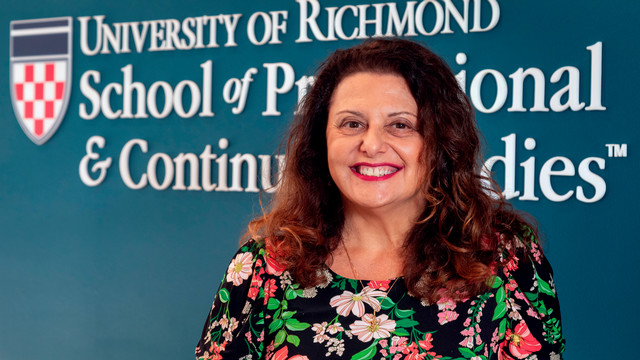
For nearly three decades, Laura Fortunato was a trusted voice behind one of the most influential financial institutions in the nation. As a key communications strategist and spokesperson for the Federal Reserve Bank of Richmond, she spent years translating complex economic policy into clear, accessible language for the public. Today, she’s trading in press briefings and economic outlooks for community advocacy, and she couldn’t be more energized by the change.
“I love connecting with people and connecting them to knowledge that expands their thinking and enhances their community’s wellbeing,” Fortunato said. That passion has guided her across every chapter of her career from newsroom deadlines to nonprofit development work.
Fortunato’s journey from government communicator to nonprofit champion is deeply personal and deeply rooted. She grew up in Aliquippa, a small steel town outside Pittsburgh, Pennsylvania. Though an only child, she was surrounded by what she calls a "circle of love and support" from a large extended family. She credits her upbringing and Catholic education with instilling a strong sense of service and social responsibility.
“I earned bachelor’s and master’s degrees from Villanova University,” said Fortunato. “In addition to my studies in communications and political science, I grew to appreciate our responsibility in using individual talents in service to others and to contribute uniquely to our community and world.”
Through her years with the Fed, she rose through the ranks, serving as spokesperson for 15 of those years. “My work involved the use of a variety of communications channels and strategies to tell the Fed’s story, forging relationships with communities in the Richmond Fed’s five-state region, and communicating with the public and media,” she stated.
But in 2024, Fortunato stepped away from federal service, drawn by a desire to make a more immediate impact. “That year I transitioned from public servant to community advocate serving nonprofits in Virginia and North Carolina,” she explained.
In 2025, Fortunato worked as a development associate at Northstar Academy, a nonprofit school in Glen Allen, Virginia, serving students with disabilities. Her work focused on fundraising, communications, and outreach — and she was instrumental in organizing the school’s major fundraising event, The Illumination Gala.
“The school is amazing in its commitment to helping students develop and use their talents in unique ways and has an incredibly rich story behinds its community of support,” she commented.
That ethic of service — especially youth education and wellbeing — has shaped her volunteer work as well. In recent years, she’s helped build beds for children in need with Sleep in Heavenly Peace, judged student speech competitions through The Richmond Forum, and reviewed grants for underserved neighborhoods with NextUp.
IOP is playing an important role that will empower business, government and academic leaders, and community advocates to positively impact Virginians.
“I believe it’s critically important that we create supportive environments for young people to grow and learn and help equip them to meet life’s challenges,” she added. “We each have individual talents that collectively can create strong, stable networks that help youth develop resilience in this modern society.”
Fortunato owns a small consulting business, Fortunato Consulting LLC, where she supports several nonprofits with her communications talents. She recently joined the board of the Virginia Press Women’s Foundation, a nonprofit that aids career development and excellence in communications.
Much of her transition into nonprofit work has been shaped by her experience with the University of Richmond’s Institute on Philanthropy (IOP). She first attended the Grant Writing Institute in fall 2024.
“It offered much more than I expected but much of what I needed to build an effective knowledge base,” she emphasized. “In addition to learning about researching, writing and evaluating grants, the instructors provided a comprehensive overview of philanthropy, fundraising, donor relations and network building.”
The IOP also introduced her to ways of improving efficiencies. In February 2025, she returned to UR to take the AI-Assisted Grant Writing course, which focuses on utilizing Artificial Intelligence to enhance storytelling and strengthen proposals. Once again, she found herself surrounded by “dedicated practitioners from various nonprofits and foundations who all shared generously.”
Based on her experience, Fortunato believes the work being done through the Institute on Philanthropy speaks directly to the challenges and opportunities facing communities today.
“I believe the IOP is playing an important role in developing knowledge and connections that will empower business, government and academic leaders, and community advocates to positively impact Virginians,” she clarified.
Even as her professional focus shifts, Fortunato remains committed to applying the skills she honed over decades. “I hope to incorporate the creative thinking and the strategic focus that has been part of my previous work to the nonprofit work I am doing now,” she commented.
And she’s not stopping there. As an avid swimmer, Fortunato is eyeing her next mission: “I also would like to engage in a community project that would bring my passion for swimming into play, one that would help advance advocacy around drowning prevention.”
Long after the final session at the Institute on Philanthropy ended, Fortunato says the conversations and ideas from the class are still shaping her work. In organizing nonprofit events, venturing into a new career, and day-to-day problem-solving, she finds herself returning to what she learned about networking, collaboration, and strengthening communities.
“It certainly has played a role in my ability to tap into opportunities for exchanging knowledge and support,” Fortunato remarked.
And as new challenges emerge in the community she serves, Fortunato says she feels better prepared than ever — not just with new strategies, but with a renewed commitment to the people at the heart of her work.