From learning to impact: Dr. Jennifer Smith‑Slabaugh’s call to keep growing
SPCS Commencement
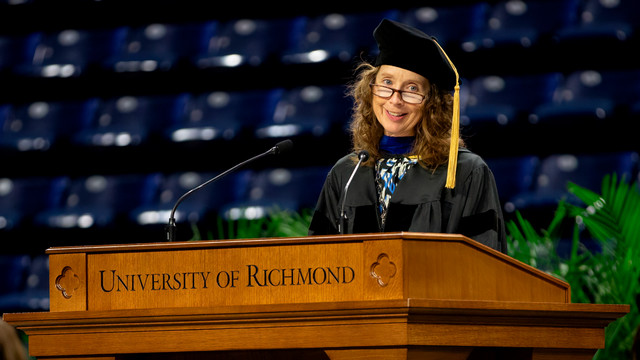
When Dr. Jennifer J. Smith‑Slabaugh stepped to the podium at the University of Richmond School of Professional and Continuing Studies (SPCS) Commencement exercises on May 9, 2026, she offered graduates a simple but demanding charge: Keep learning, and let that learning serve others. “If you remain committed to lifelong learning, you will never be left behind,” she told members of the class of 2026. In a rapidly changing world, she added, thriving requires curiosity, and humility.
Smith‑Slabaugh addressed graduates as the 2026 Itzkowitz Family Distinguished Adjunct Faculty Award winner, an award selected from among SPCS student nominations. The recognition reflects a decade of teaching in the School’s nonprofit studies program, where since 2015 she has taught Community Engagement in the Nonprofit Sector, Program Design & Proposal Writing, and Volunteer Management. In these courses, students practice the habits she champions — ask better questions, read widely, listen deeply, and learn from failure with “the courage to try again with greater wisdom.”
Her message was born of experience. Nearly twenty years ago, she finished a terminal degree in the evenings while working full‑time and raising a family — an effort she now frames as a long chapter in an ongoing book. “What I didn’t quite understand then is that there is no such thing as a terminal degree,” she reflected. Education, in her telling, remains a resource to share. She encouraged graduates to give their “time, talent or treasure,” mentoring those just starting out, serving on nonprofit boards, and advocating for those whose voices can be overlooked. “When learning is paired with generosity, it has the power to become something so much greater — it becomes impact,” she said.
SPCS has been central to that vision. Through applied projects, practitioner‑led instruction, and a network rooted in Greater Richmond’s nonprofit ecosystem, the School equips working professionals to translate classroom learning into measurable community outcomes. Smith‑Slabaugh’s students design programs, write competitive proposals, and build volunteer systems that strengthen organizations. As she noted, teaching is a reciprocal event: “I learned just as much from my students as I did sharing the knowledge with them.”
Smith-Slabaugh closed with a vision of shared achievement. She saw outstanding faculty, supportive families and friends, and — most of all — a “diversity of hope.” On behalf of SPCS, she wished the graduates a life marked by curiosity, kindness, and service. “Use what you have learned here to build bridges, not walls,” she urged. That, she suggested, is how learning becomes impact.