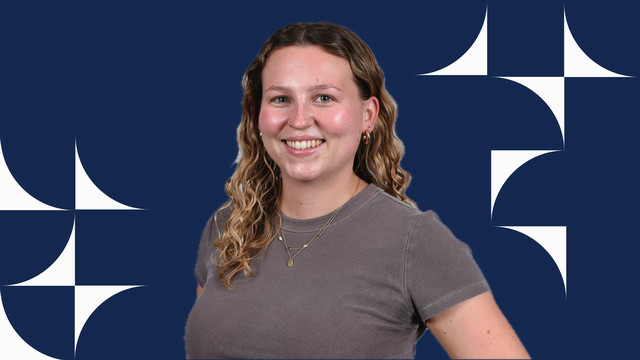
Art in practice: Clara Swartz, GC’25, brings creative confidence to the elementary classroom
SPCS Commencement
When Clara Swartz enrolled in the Master of Education in Curriculum & Instruction at the University of Richmond’s School of Professional and Continuing Studies (SPCS) in January 2024, she set a clear goal: To become the kind of art educator who could spark creativity and confidence in every elementary learner.
Less than two years later, she completed her M.Ed. in December 2025 and, at SPCS Night on May 6, 2026, received the James W. Lanham Book Award for Excellence in Curriculum and Instruction while being recognized among Curriculum & Instruction students whose graduate capstone projects passed with distinction.
A lifelong Richmonder, Swartz selected SPCS for its reputation and flexibility. “Being from Richmond, I knew that UR offered rigorous courses with outstanding professors,” she said. “I quickly learned that in SPCS I would be challenged but also supported. I loved that I could take the courses at my own speed.” That balance mattered as she launched her career as an art teacher at Lewis and Clark Elementary in Caroline County.
Starting the program in her student-teaching semester shaped the way she entered the teaching profession. “The Master of Education in Curriculum and Instruction at UR checked all my boxes,” Swartz explained. “I was able to start the next semester, immediately applying what I was learning in my courses to my first year of teaching. It was a seamless transition that made starting my career less daunting.” Coursework in curriculum design and assessment aligned closely with what her young artists needed most — structured opportunities to explore, reflect, and grow.
The demands of a first year in the classroom made time management a central challenge. “Balancing work and school was challenging, especially as a first-year teacher, but it also made finishing that much sweeter,” she noted. Faculty mentoring and the program’s pacing options helped her maintain momentum without sacrificing instructional quality. The culminating capstone project — in which she integrated developmentally appropriate studio practices with evidence-based assessment — underscored how research and reflection can elevate arts learning.
Swartz credits the encouragement of high school art teachers, who “saw that potential in me and encouraged it,” for her decision to become a teacher. That formative support, strengthened by SPCS faculty who modeled rigorous, relational teaching, deepened her conviction that art education builds durable skills far beyond the studio. “I learned to follow my passions, to ask for help, and never to stop learning,” she said. “I knew there was more to learn but this program expanded my knowledge farther than I could have imagined.”
Looking ahead, Swartz intends to remain in the elementary classroom. “I plan to be in the classroom for a long time. I love working with elementary age students and guiding their exploration and creation,” she shared. With an award-winning capstone, a strong professional network, and advanced skills in curriculum and assessment, she continues to translate SPCS learning into daily practice — helping young artists discover that creativity is both a process and a pathway to confidence.